REVIEW · NAPLES
Pompeii La Tagliata Restaurant Drive
Book on Viator →Operated by city & tour soc coop arl · Bookable on Viator
Pompeii and Positano in one day sounds wild.
What makes it work is the simple plan: you get guided logistics to two UNESCO places, plus time to wander at your own pace. I love how the Pompeii stop hits the big set pieces (Forum, amphitheatre, baths, and the theatres) without making you feel rushed. I also love the Amalfi Coast drive that keeps rewarding you with sea views as the day moves along.
Another reason I liked it is how the day feels like a proper escape, not a frantic airport-style sprint. The team handles the pickup and drop-off at set meeting points, and the lunch stop at La Tagliata has a real following for a reason: great food and those don’t-sit-still-that-way-too-long views. One possible drawback: Pompeii entrance fees aren’t included, and Pompeii requires an identity card, so you’ll want to plan that before you go.
In This Review
- Key Things You’ll Notice Right Away
- How the Day Flows: Naples to Pompeii, Then Positano
- Pompeii Archaeological Park: The Forum, Theatres, Baths, and the Vesuvius Look
- The Pompeii Forum: Where the city acted like a city
- Pompeii Amphitheatre: Gladiators and crowd energy
- Lupanar: A complicated place you can’t ignore
- Stabian Baths: Rome’s hot-cold routine, frozen in stone
- Teatro Grande and Teatro Piccolo: the theatres plus the Vesuvius view
- Don’t miss this: bring your ID and time your entry
- About guides inside Pompeii
- Positano Town: Spiaggia Grande, Santa Maria Assunta, and the Fornillo Calm
- Spiaggia Grande: the main beach and the busy promenade vibe
- Chiesa di Santa Maria Assunta: the majolica dome and the Black Madonna
- Spiaggia di Fornillo: a calmer beach reached by a panoramic walk
- La Tagliata Lunch: Why This Stop Gets Mentioned Again and Again
- A small practical point
- Price and Value: What $291.69 Really Covers
- Pickup, Timing, and Getting There Without Losing Your Mind
- If you’re doing this from Rome by train
- For cruise passengers
- Safety and valuables
- Who This Tour Fits Best (and Who Might Not Love It)
- Should You Book This Pompeii and Positano Day Trip?
- FAQ
- How long is the Pompeii and Positano day trip?
- Is Pompeii admission included in the price?
- Will I have an English guide inside Pompeii?
- Do I need identification to enter Pompeii?
- Where are pickup and drop-off locations?
- Is this tour private?
Key Things You’ll Notice Right Away

- Pompeii time that’s big on the essentials like the Forum, amphitheatre, Lupanar, Stabian Baths, and the theatres
- A Vesuvius viewpoint you can catch from Teatro Grande during Pompeii time
- Positano stops built around views, including Spiaggia Grande and a quieter option at Spiaggia di Fornillo
- Lunch at La Tagliata where people go specifically for the food and the setting
- Pickup and drop-off from designated meeting points, with helpful pacing for photos along the drive
- English-speaking driver/guide for the day, plus the option to add a Pompeii guide on site
How the Day Flows: Naples to Pompeii, Then Positano

This tour is designed for a full day without the usual headache. You start in Naples, then head out for Pompeii first, and finish in Positano on the Amalfi Coast side. It runs about 8 hours, and you’ll have set times in each main area.
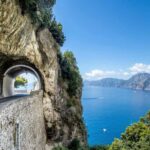
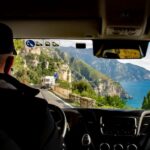
The driving is part of the experience here. As you head toward the coast, you get repeated chances to look out at the sea and coastline, and there are usually photo stops on the way. If you’re doing this as a cruise excursion or working around train schedules, that rhythm helps a lot.
Other Pompeii tours we've reviewed

Pompeii Archaeological Park: The Forum, Theatres, Baths, and the Vesuvius Look
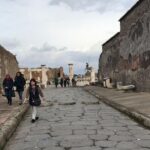
Pompeii can feel overwhelming at first. It’s huge, and you’re walking through layers of real life that froze in time. The good move is to focus on the most important areas, and this schedule does that for you.
The Pompeii Forum: Where the city acted like a city
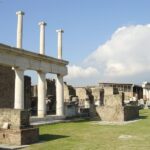
I like that you don’t just see random ruins—you get the city’s core. The Pompeii Forum is where political, economic, and religious life centered, so it gives you the best mental map. You’ll see remains connected to major spots like the Temple of Jupiter, the Basilica, and the Macellum.
If you’re the type who likes to understand how people lived, this part helps everything else click. And even if you’re not a Roman-history superfan, it still reads like a city square once you’re standing there.
Pompeii Amphitheatre: Gladiators and crowd energy
Next up is the amphitheatre, one of the oldest Roman ones, dating to around 80 BC. It was built for big shows and gladiator fights, so it’s made to handle crowds and noise. The shape alone helps you imagine the scale—this wasn’t a quiet little event.
You’ll get a sense of why the Romans were so good at designing places for mass gatherings. It’s a different kind of “wow” than the buildings themselves.
Lupanar: A complicated place you can’t ignore
The Lupanar is one of those Pompeii stops that people either rush past or study too long. It’s the ancient brothel, with small rooms and frescoes tied to erotic imagery. Keep your expectations realistic: it’s an archaeological site, not a museum-style show, so the experience is more about context than comfort.
I think it’s still worth it because it rounds out Pompeii beyond temples and temples-only. You see daily life in a less polite light, and that matters for understanding what a city really contained.




Stabian Baths: Rome’s hot-cold routine, frozen in stone
Then there are the Stabian Baths, known as one of the oldest thermal complexes in the Roman world. You can spot spaces connected to hot and cold baths and even saunas. It’s a reminder that bathing wasn’t a once-a-week event for Romans—it was part of social life.
If you like places where routines lived, this is a strong stop. Baths show how architecture served behavior, and Pompeii lets you see that clearly.
Teatro Grande and Teatro Piccolo: the theatres plus the Vesuvius view
Pompeii’s theatres add two things at once. Teatro Grande and Teatro Piccolo are among the best-preserved theatre spaces, used for performances over time. And here’s a practical perk: from Teatro Grande, you can enjoy a splendid view of Vesuvius.
That Vesuvius view changes how you understand the whole site. It makes the ruins feel connected to the volcano instead of like they’re just sitting there. Even a short pause to look back out at the mountain is worth it.
Don’t miss this: bring your ID and time your entry
Pompeii entrance fees aren’t included, listed at 18 euros per person where applicable. Also, Pompeii requires an identity card to enter the site—so bring the ID you’re using for travel.
One more practical tip: coordinate with the office about your Pompeii entrance time before you buy tickets. Pompeii days can run on strict entry timing, and lining this up early saves stress when the day is already full.
About guides inside Pompeii
You’ll have an English-speaking driver/guide for the day’s driving and orientation. For deeper explanations inside Pompeii, you can hire a guide on site, at your own expense.
In past departures, the team has also arranged Pompeii specialists with names like Grace, so you may see options for structured interpretation once you’re there. If you want that story-driven experience, plan to add a guide rather than trying to read everything yourself at speed.
Positano Town: Spiaggia Grande, Santa Maria Assunta, and the Fornillo Calm
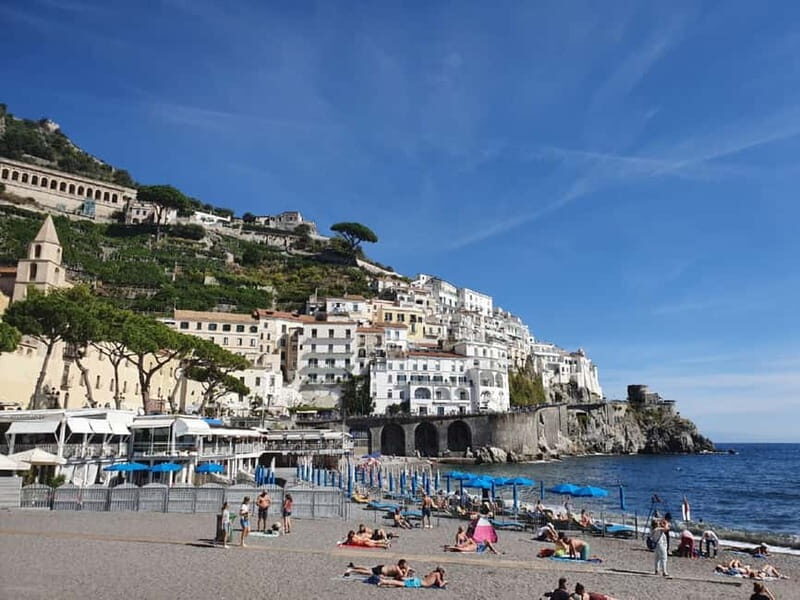
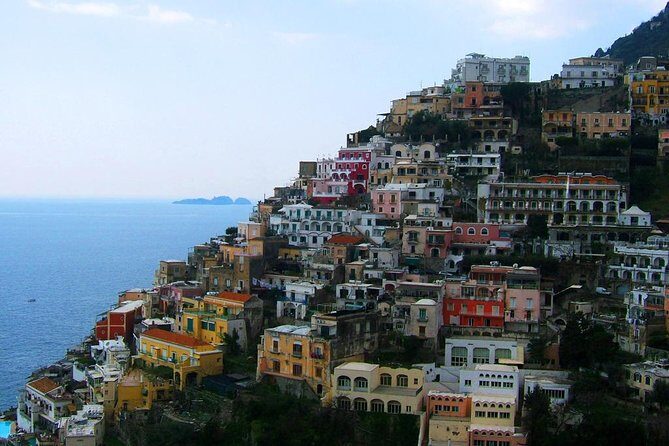
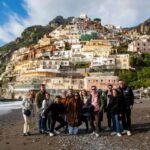
After Pompeii, the day shifts from archaeological gravity to coastal postcard charm. Positano is one of the most iconic towns on the Amalfi Coast, with homes stacked up the hillside above the sea.
You’ll get about 2 hours in Positano, which is enough time to do one or two priority things well.
Spiaggia Grande: the main beach and the busy promenade vibe
Spiaggia Grande is the main beach. It’s the easiest place to orient yourself because you’ll find plenty of bars and restaurants along the area, and it’s also where the more lively club scene tends to show up.
I like using Spiaggia Grande as your starting point because you get the view right away and you can decide how fast you want to move after that.
Chiesa di Santa Maria Assunta: the majolica dome and the Black Madonna
Then go for Chiesa di Santa Maria Assunta, the symbol of Positano. The church is known for its colorful majolica dome and for a Byzantine icon of the Black Madonna kept inside.
Even if you’re not church-first, the dome is worth seeing in person. It’s one of those details that photos don’t fully explain.
Spiaggia di Fornillo: a calmer beach reached by a panoramic walk
If you want a quieter moment, head toward Spiaggia di Fornillo. It’s generally less busy than Spiaggia Grande, and it takes a panoramic walk to get there. This is the spot for people who want to breathe a little during a packed day.
Two hours can vanish fast in Positano, mostly because you’ll keep wanting to stop for views. For that reason, I recommend picking one beach and one key church stop and sticking to it.
La Tagliata Lunch: Why This Stop Gets Mentioned Again and Again
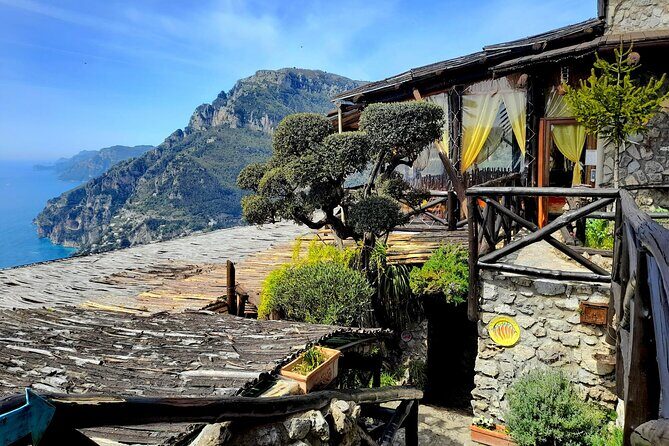
Lunch is at La Tagliata, and it’s part of why this day feels like a complete experience instead of just “ruins plus views.” The team typically brings you there and waits while you eat, which is a big deal when your day is already tight.
Based on what people said, La Tagliata is the kind of place where the food arrives with confidence. One review notes a menu with lots of included items: salads, handmade pasta, and meat dishes like rabbit and different cuts, plus sides moving along without you having to constantly decide.
Another common theme is that the food plus the view is the whole point. If you’re expecting a quick snack, you might leave full and happy enough to call it a win. If you’re truly hungry, it’s the right kind of stop for that too.
A small practical point
If you have a sensitive stomach or you’re easily heat-stressed, pace yourself. The day includes a long drive and walking in Pompeii, and lunch can be a lot. Plan water breaks and take it slow for the first course so you don’t crash.
Price and Value: What $291.69 Really Covers
The price is $291.69 per person, and it helps to understand what you’re paying for. You’re not paying for a museum-style guided tour of every room. You’re paying for the hard parts: transport, time management, and keeping your day organized across two major destinations.
Included in the price:
- English-speaking driver/guide
- All tolls, parking, petrol (gas), and taxes
- Pickup and drop-off from designated meeting points
- A mobile ticket
Not included:
- Pompeii entrance fees (noted as 18 euros per person)
- A Pompeii guide inside the park (you can hire one on site)
- Anything you choose at lunch beyond what La Tagliata includes for your meal
In plain terms, this is good value if you want the convenience of a smooth plan and you’d rather spend your energy on seeing than managing transit. It’s also a solid choice for families and first-timers because the day doesn’t demand expert navigation skills.
If you’re the kind of traveler who already knows Pompeii like a textbook and only wants self-guided time, you might feel the price is mostly for logistics. But if you’d rather have someone else handle the driving and timing, the cost starts to make sense fast.
Pickup, Timing, and Getting There Without Losing Your Mind

The tour works smoothly because pickup and drop-off are handled from meeting points, not random meetups. You’ll also be operating in a real travel day, so being punctual matters.
Also pay attention to the tour’s “smart casual” dress code. It’s not a formal dinner, but you shouldn’t show up in beach-only gear either. Comfortable walking shoes are a must, because Pompeii and Positano involve plenty of uneven terrain and stairs.
If you’re doing this from Rome by train
If you’re starting in Rome, there’s a suggested plan that fits this tour format. You’d take the Freccia Rossa Fast Train from Rome Termini at 7:35 am to Naples Centrale at 8:45 am, and the team picks you up right from the station. At the end of the day, you drive back in Naples so you can catch a train back to Rome, with a suggested departure around 6:30 pm.
Train days always have stress built in. This routing helps because it gives you a concrete timeline instead of guesswork.
For cruise passengers
The day includes a note about ensuring timely return to the port. That’s not a small detail. Cruising adds consequences for late buses, so the focus on return timing is a real comfort.
Safety and valuables
They also note they’re not responsible for loss of personal items or valuables left in vehicles during free time. So keep your essentials on you, and don’t treat the car like a locker.
Who This Tour Fits Best (and Who Might Not Love It)
This is a great fit if you want:
- One day that checks off Pompeii plus Positano
- Convenient transport from Naples or Naples-area arrival points
- A mix of big sights and personal free time
- Lunch at La Tagliata as a planned break (not an afterthought)
It may be less ideal if you want a slow, deeply guided experience inside Pompeii with constant expert narration. The driver handles the day. For detailed Pompeii interpretation, you’ll either read on your own or hire a guide on site.
Should You Book This Pompeii and Positano Day Trip?
If you want a practical, high-impact day and you don’t want to spend hours coordinating trains, buses, and entry timing, I’d book it. Pompeii hits the major “don’t miss” areas, Positano gives you beach-and-church time, and the La Tagliata lunch stop turns the day from sightseeing into a proper meal break.
Book it especially if you’re traveling with family, doing a first trip to Naples, or you’re short on time but still want the feeling of seeing two UNESCO areas in one day. Just make sure you pack your ID, budget for Pompeii entrance, and give yourself permission to move at a calm pace inside each area.
FAQ
How long is the Pompeii and Positano day trip?
It runs about 8 hours (approx.).
Is Pompeii admission included in the price?
No. Pompeii entrance fees aren’t included, and Pompeii is listed at 18 euros per person where applicable.
Will I have an English guide inside Pompeii?
You’ll have an English-speaking driver/guide for the day, but it’s driver only for visits. A Pompeii guide can be hired on site.
Do I need identification to enter Pompeii?
Yes. An identity card is required to enter the site, so bring your ID on the tour day.
Where are pickup and drop-off locations?
Pickup and drop-off happen from designated meeting points. The day also notes pick-up at the Naples train station if you’re arriving by train from Rome.
Is this tour private?
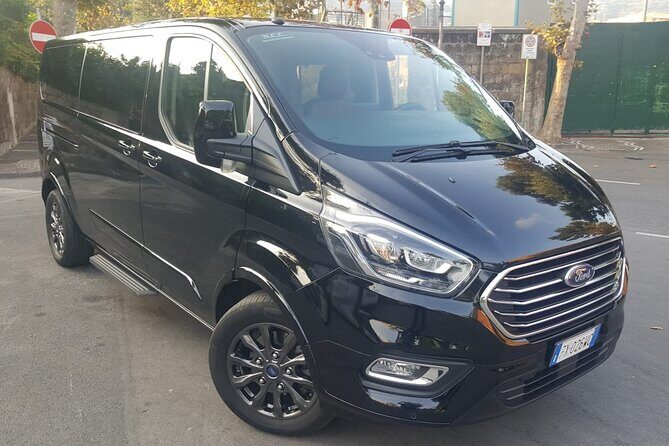
Yes, it’s private, and only your group participates.